
The Nuremberg Egg: Myth and Reality
Four things are usually said in one breath: that the first watch was made in Nuremberg, that Peter Henlein made it, that it was called a Nuremberg egg, and that it was egg-shaped. The last one is the easiest to check, and it is wrong. The oval watches that the phrase actually describes became fashionable around 1580. Henlein died in 1542.
That is the pattern of the whole story. Almost every element of it is a real thing that has been moved to the wrong place — a real craftsman, a real contemporary description, a real shape of watch, a real museum object — assembled three centuries later into a claim that none of them supports on its own.
The Watch That Settled It Was a Fake
In 1897 the Germanisches Nationalmuseum in Nuremberg acquired a small drum-shaped watch signed on the inside of the back cover: Petrus Hele me f(ecit) Norimb(erga) 1510 — Peter Hele made me, Nuremberg, 1510. It is difficult to imagine a more convenient object. A Henlein anniversary was approaching, the German trade wanted a founder, and here was one signed and dated.
The museum barely mentioned it. Experts had doubted the watch from the moment it arrived, and a museum guide of 1930 already recorded that the signature was without doubt a forgery, added at a later date. The inscription is atypical in its lettering, and it runs across scratches that were already on the metal — so the scratches came first and the signature came afterwards.
In 2013 and 2014 the museum put the watch through raking light and 3D computer tomography, with the Fraunhofer institutes in Fürth. The imaging showed a movement whose parts do not belong together and whose components carry markedly different patterns of wear. Repairs alone will not explain it: the underlying design is too inconsistent to have ever been one coherent watch. The museum's conclusion was that the object is largely a construction of the late nineteenth century, repeatedly altered, and possibly a forgery entire.
What the One Contemporary Source Actually Says
Strip away the nineteenth century and one piece of evidence remains from Henlein's own lifetime. In 1511 the humanist Johannes Cochläus added a eulogy of Nuremberg to his edition of Pomponius Mela's Cosmographia, and in it he wrote that Peter Hele, still a young man, makes works that even the most learned mathematicians admire: out of a little iron he makes clocks with many wheels which, however they are turned, show and strike the hours for forty hours without any weight, even when carried at the breast or in a purse.
Read it carefully and notice what it does not say. It does not say Hele invented anything. It says he was young, that he was good, and that his clocks ran without weights and could be carried — which is a description of a spring-driven portable clock, a thing that already existed. The mainspring that made such clocks possible appeared in the early fifteenth century, roughly a century before Henlein, and spring-driven clocks survive that predate his work.
The archives give a similar picture: a competent, prosperous, well-connected craftsman rather than a lone genius. Henlein trained as a locksmith — one of the few trades with the tools and the touch to move into clockmaking. He took sanctuary in the Nuremberg Franciscan monastery from 1504 to 1508 after a fellow locksmith was killed in a brawl, became a master in November 1509, was paid 15 gulden by the city in 1524 for a gilt pomander with a clock mechanism in it, travelled to Strasbourg for the council in 1529, built a tower clock for Lichtenau castle in 1541, and died in August 1542.

The Name Is a Mistranslation
The German Eierlein, little eggs, is a corruption of Ueurlein or Äurlein — modern Ührlein, little clocks, from Middle Low German ûr and ultimately Latin hora. The slip appears to have been made in print by Johann Fischart, who in his 1571 German version of Rabelais rendered an instance of Ueurlein as Eierlein.
The consequence is the strangest part of the story. The mistranslation may have helped make the shape fashionable rather than the other way round: oval cases became popular from about 1580, after the name was already circulating. If that is right, the Nuremberg egg is a watch that was named before it was designed.
What the Earliest Watches Actually Were
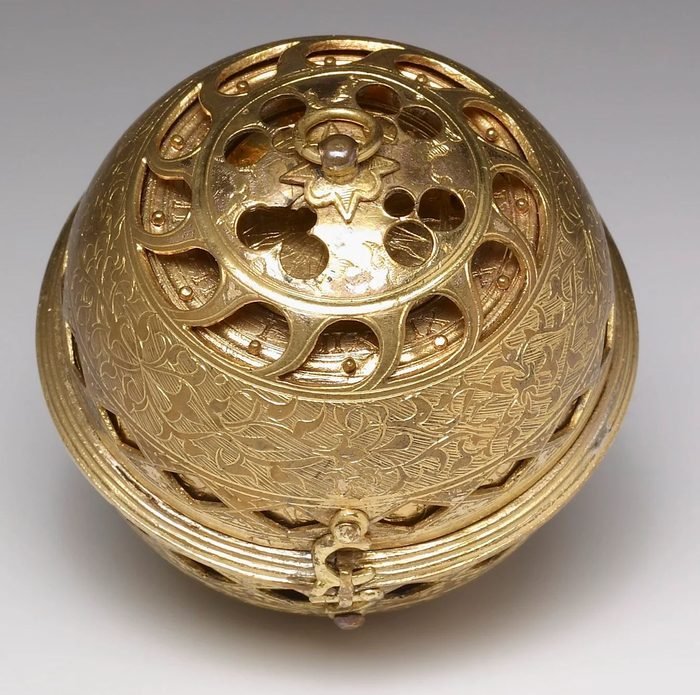
Three forms were made in early sixteenth-century Nuremberg, and none of them is an egg. The tall cylindrical drum clock, or Dosenuhr, stood on a table or travelled in a purse. The flat drum was worn on a cord round the neck. The spherical pomander watch, Bisamapfeluhr, put the movement inside the scented metal ball that wealthy people already carried against plague and stench.
All of them shared the same limits. One hand. Hours only, often read through pierced holes in a closed case. A verge escapement with no balance spring, so the rate depended on how the watch was carried and how far the mainspring had run down. Melanchthon's watch, the best-documented survivor, ran twelve to sixteen hours on a wind and kept time to about the nearest half hour. These were not instruments. They were jewellery that moved.
| The claim | What the evidence supports |
|---|---|
| Henlein invented the watch | Refuted. No contemporary source says so; the attribution begins in 1730 |
| Henlein invented the mainspring | No. It appears in the early 1400s, a century earlier |
| Henlein made small portable clocks | Yes. Attested in 1511 and in the city accounts |
| The signed 1510 watch is his | No. Signature forged; movement largely 19th-century |
| Nuremberg egg means egg-shaped | No. A mistranslation of Ueurlein, little clocks |
| Egg-shaped watches are Henlein's | No. The oval form dates from c. 1580; he died 1542 |
| Nuremberg mattered to early watches | Yes. A leading centre, with Augsburg |
The One You Can Still Look At
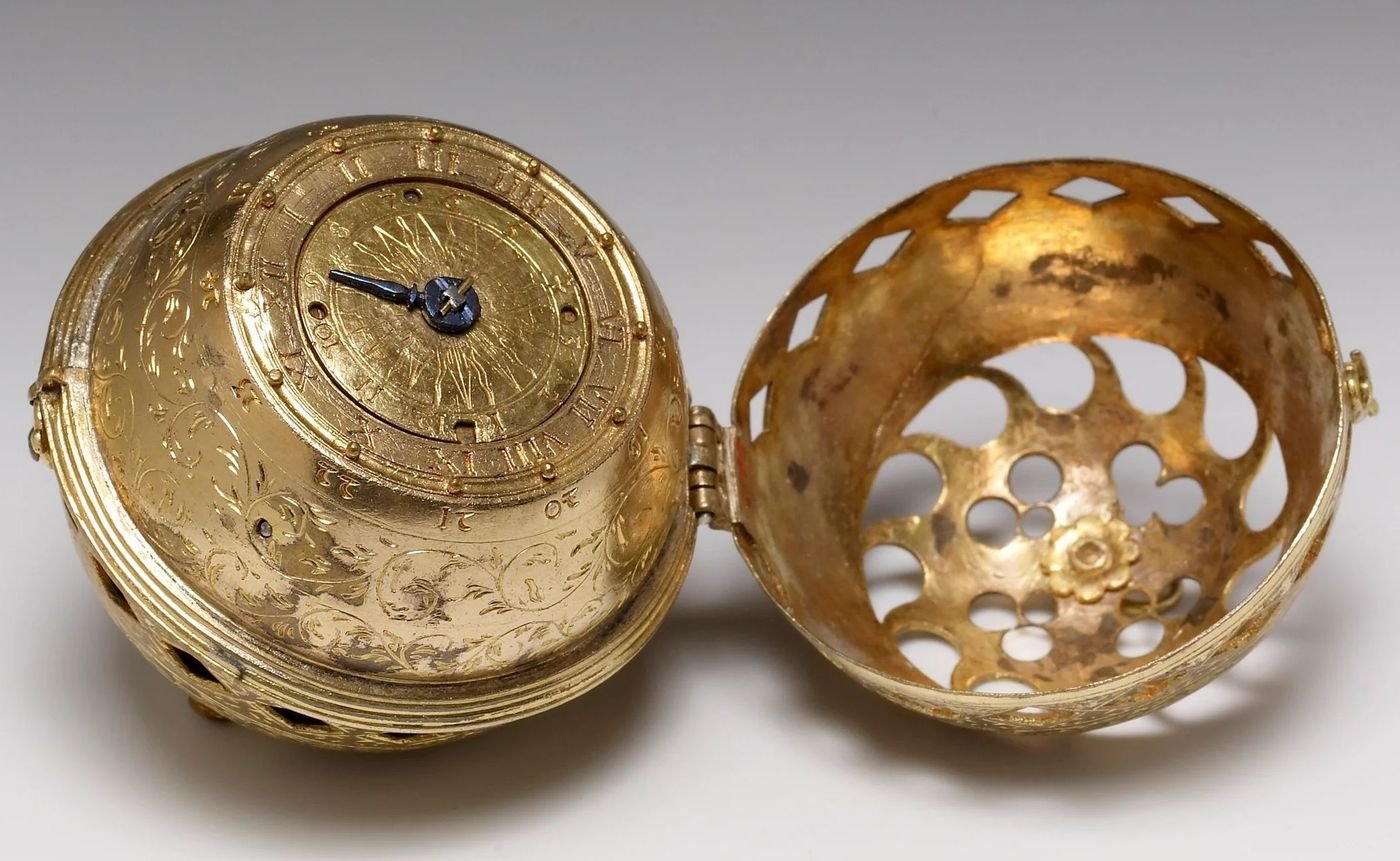
For an object that is not in dispute, go to Baltimore. The Walters Art Museum holds a spherical gilt-brass watch engraved on the underside PHIL. MELA. GOTT. ALEIN. DIE. EHR. 1530 — Philip Melanchthon, to God alone the glory. It is the earliest dated watch known to survive; fewer than a handful of watches of any kind predate 1550, and only two carry dates, this one and one of 1548. It is about 4.8 by 5 centimetres, gilded brass outside and an iron movement within, and the museum releases its photographs of it under CC0.
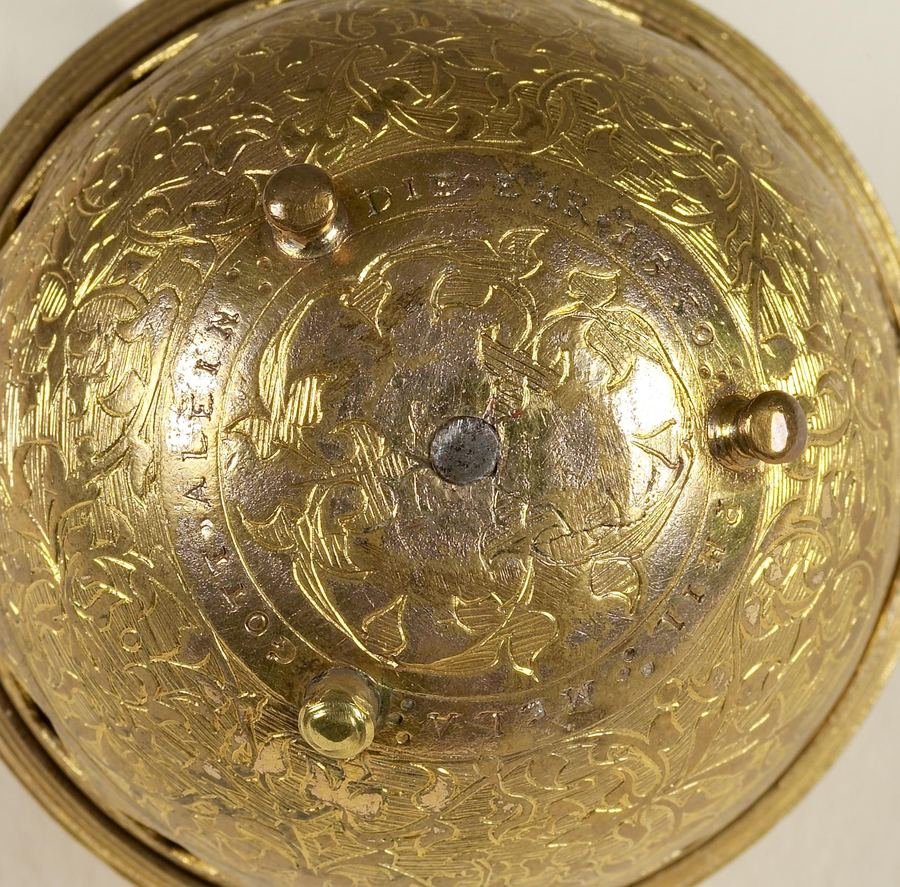
It has no maker's mark. In 2014 scholars concluded that its characteristics are consistent with an attribution to Henlein — which is a careful sentence, and worth reading as carefully as the Cochläus passage. Consistent with is not the same as by. It is the strongest honest statement available, and it is a great deal weaker than a signature on a back cover.
How Henlein Became the Inventor
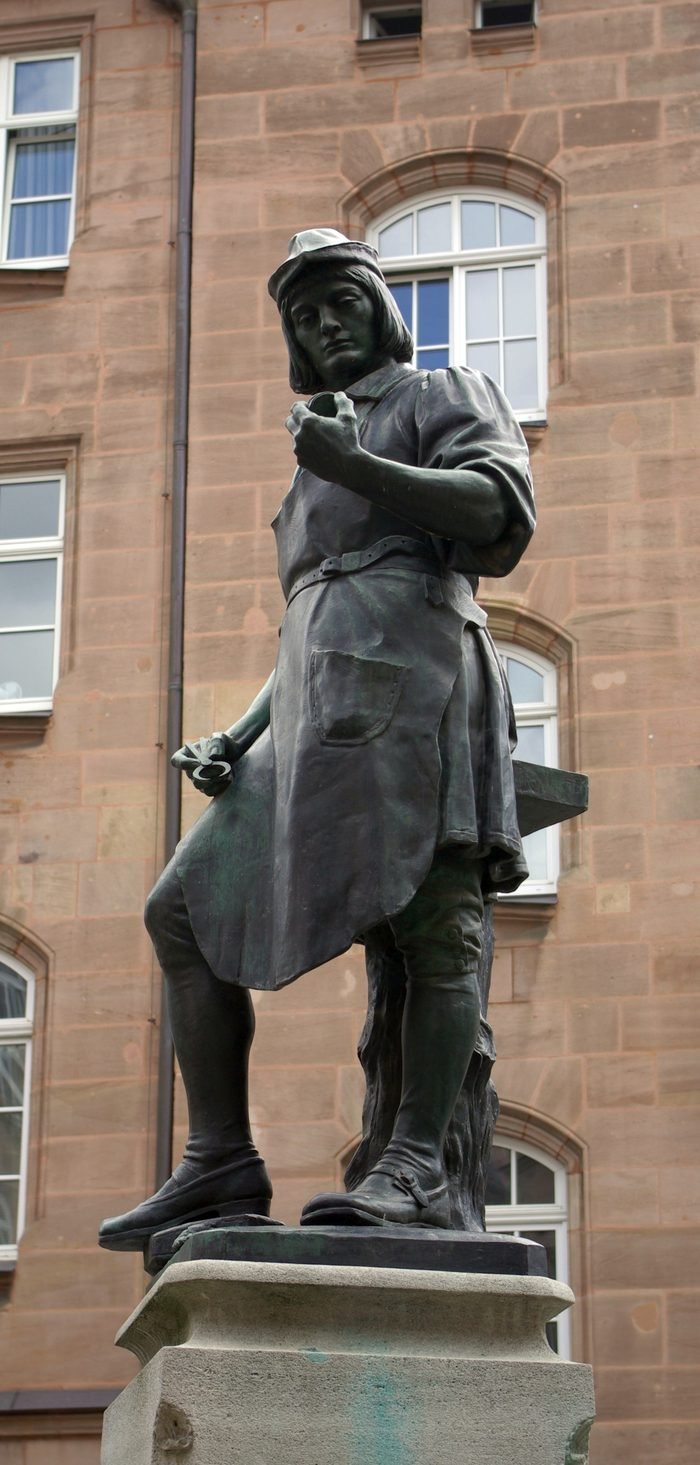
The chain is traceable. In 1730 the Nuremberg mathematician Johann Gabriel Doppelmayr, compiling the lives of the city's mathematicians and artists, credited Henlein with the invention. In the nineteenth century the history of technology became national property, and a German inventor of the watch was wanted; Karl Spindler's novel put Henlein in front of a popular audience. The Walhalla memorial named him inventor of the pocket watch in 1842. The signed watch surfaced in 1897, and in 1905 Nuremberg and the German watchmakers' association celebrated a four-hundredth anniversary and built him a fountain.
After 1933 the remaining scholarly doubts were simply set aside. Veit Harlan filmed his life as Das unsterbliche Herz, a stamp of 1942 called him the inventor of the pocket watch, and schoolbooks followed. The Encyclopaedia Britannica still carried the attribution in 1990. The museum that owns the watch now states the modern position plainly: the invention of the portable watch has no inventor. It was solved in several European workshops, at about the same time, independently.
What This Means If You Are Offered One
Two practical consequences follow, and both are about the same trap.
First, treat the words Nuremberg egg in a listing as a description of a style, never of a date. The nationalist enthusiasm that produced the museum's own forgery produced a great many others: the late nineteenth century made Renaissance-looking watches in quantity, some as honest revivals and some not, and they are what most people are actually looking at when they think they are looking at a sixteenth-century watch. Genuine oval Dosenuhren are museum objects.
Second, the failure mode is general and it is not confined to the sixteenth century. The most persuasive feature of a watch is the one most worth doubting, because persuasion is what it was added for. That is exactly how a forged signature survived in a national museum for a century, and it is the same reasoning that applies to a re-dialled Swiss watch carrying an American maker's name, or to a case whose engraving is bolder than the rest of its wear would suggest.
The short version. Nuremberg was a real centre of early watchmaking. Peter Henlein was a real and capable maker of small portable clocks, praised in print in 1511. He did not invent the watch, he did not make the watch that bears his forged signature, and the egg is a translator's mistake that later became a fashion.
Further Reading
- History of the pocket watch — the full five-century overview this article sits at the start of.
- How to identify and date a pocket watch — what each feature settles, and what it cannot.
- Fake pocket watches — period Swiss fakes and the seven things that give them away.
- The fakes guide — four categories of fraud, including watches assembled from unrelated parts.
- Makers' marks — why a mark is a claim rather than a proof.
- Movement types — the verge, and what came after it.
- Tompion & Graham — what happened once watchmaking acquired a scientific standard to meet.
- All Horological History articles.