
Form Watches: Skulls, Crosses and Curiosities
For roughly a hundred years the fashionable watch was not round. It was a silver skull that opened at the jaw. It was a cross worn at the girdle, a rock-crystal cockle shell, a tulip bud, a little book with hinged covers, a dog, a lamb, a heart. Collectors call these form watches — watches whose cases are made in the form of something else — and they are among the most photographed and least accurately described objects in horology.
The reason they exist is slightly deflating. The watch could not yet do its job. A verge watch of 1620 carried a single hand over a dial marked in hours, and nothing about the way it kept time was a thing a maker could put a price on. The Metropolitan Museum of Art puts it about as bluntly as a museum can: the period produced watches that were primarily jewellery which incidentally told the time, and watches meant for timekeeping, and neither variety was a very accurate timekeeper. When an instrument cannot be sold on its performance, it is sold on everything else.
What a Form Watch Actually Is
The form is the case. Inside almost every one of these objects is the ordinary gilt-brass verge movement of its decade, differing from the movement in a plain oval watch mainly in being squeezed into an awkward space. That distinction matters more than it sounds, and the last section of this article is built on it: a form watch is two objects that arrived at the same place, and they need not have arrived at the same time.
It also explains who really made them. The case was goldsmith's, enameller's and lapidary's work, and in the great centres those were separate trades from watchmaking. In Paris the boundary was fought over directly — by 1627 the watchmakers had taken from the goldsmiths the right to make their own gold and silver cases. The signature you find on the movement, when there is one, is the watchmaker's. It says nothing whatever about who cut the rock crystal or laid the enamel.
The Shapes, and What They Were For
The repertoire is wider than the skulls that dominate the picture books, and most of it is devotional, emblematic or botanical rather than macabre. A form watch was worn where it could be seen: on a chain at the neck, at the waist, pinned to a bodice. It was a statement before it was a timepiece, and the statement was usually piety, learning, wealth or wit.
| Form | What it was doing |
|---|---|
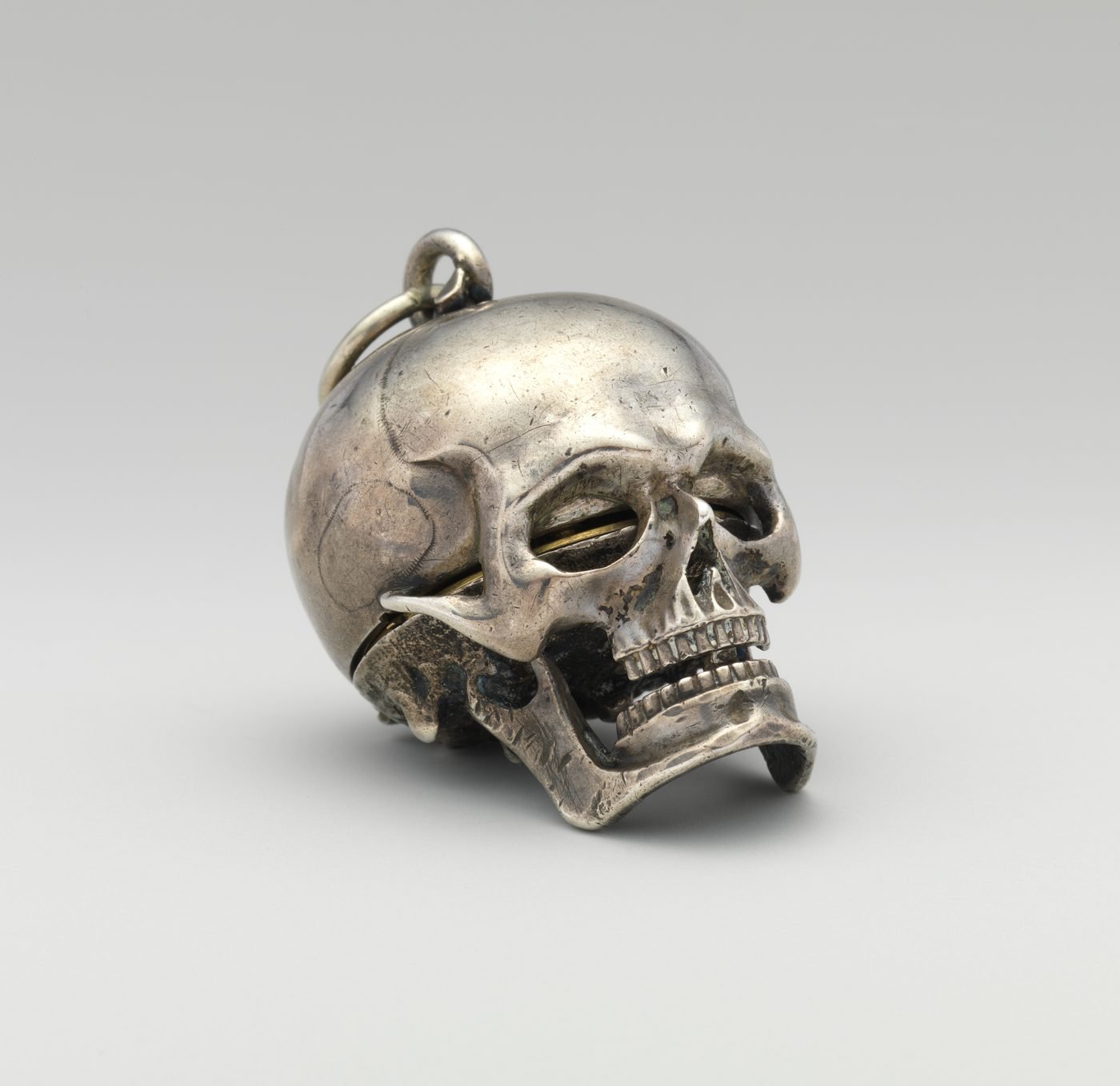
| Skull | Memento mori — a reminder of death, of a kind already common in rings, pendants and prints. The dial usually sits under a hinged jaw |
| Latin cross | Devotional, worn at the girdle or on a chain, with the dial set at the crossing of the arms |
| Book | Learning and piety together — the case opens on hinges like a bound volume |
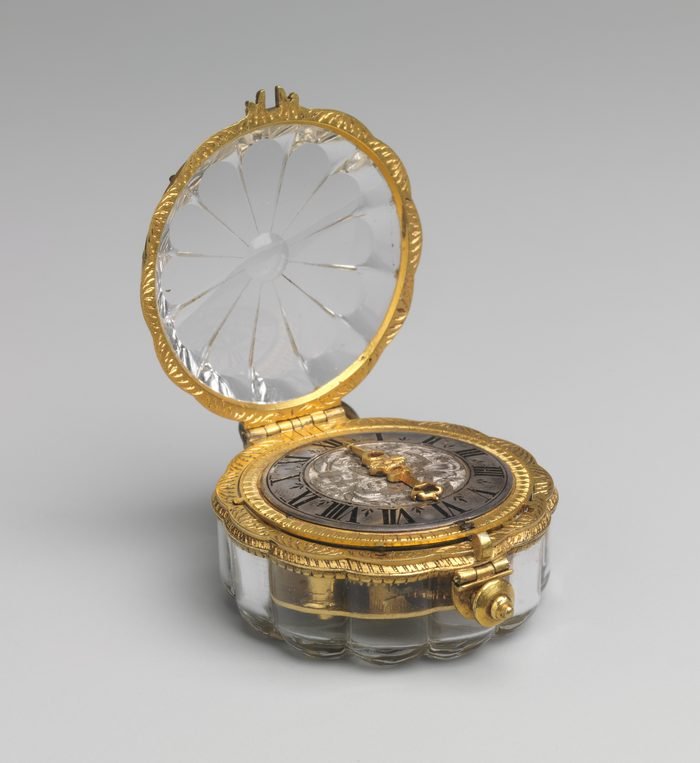
| Cockle shell | The scallop is the emblem of the pilgrimage to Santiago de Compostela; the shape also happens to suit a hinged case |
| Tulip and other flowers | Fashion and luxury, at the height of the European enthusiasm for the bulb trade |
| Animals — dog, lion, lamb | Heraldic or emblematic; the lamb reads as Agnus Dei |
| Heart, star, pomegranate | Love tokens and emblems, the commonest of the small decorative forms |
| Rock crystal, in any outline | Not a form in itself but the period's favourite material — carved, faceted, and mounted so the movement shows |
Rock crystal deserves the extra line. It is the one choice that a modern eye consistently misreads as glass and a modern description consistently calls a crystal, meaning the cover over a dial. In the seventeenth century it is the case itself: quartz, carved and polished by a lapidary, mounted in gilded brass or enamelled gold. The reason so many of the finest survive in New York is a single bequest: J. Pierpont Morgan's watch collection went to the Metropolitan Museum of Art in 1917, and the Geneva makers Jean Rousseau the Younger, Jean Cusin and Isaac Penard are all represented in it.
One Hand Is the Whole Argument
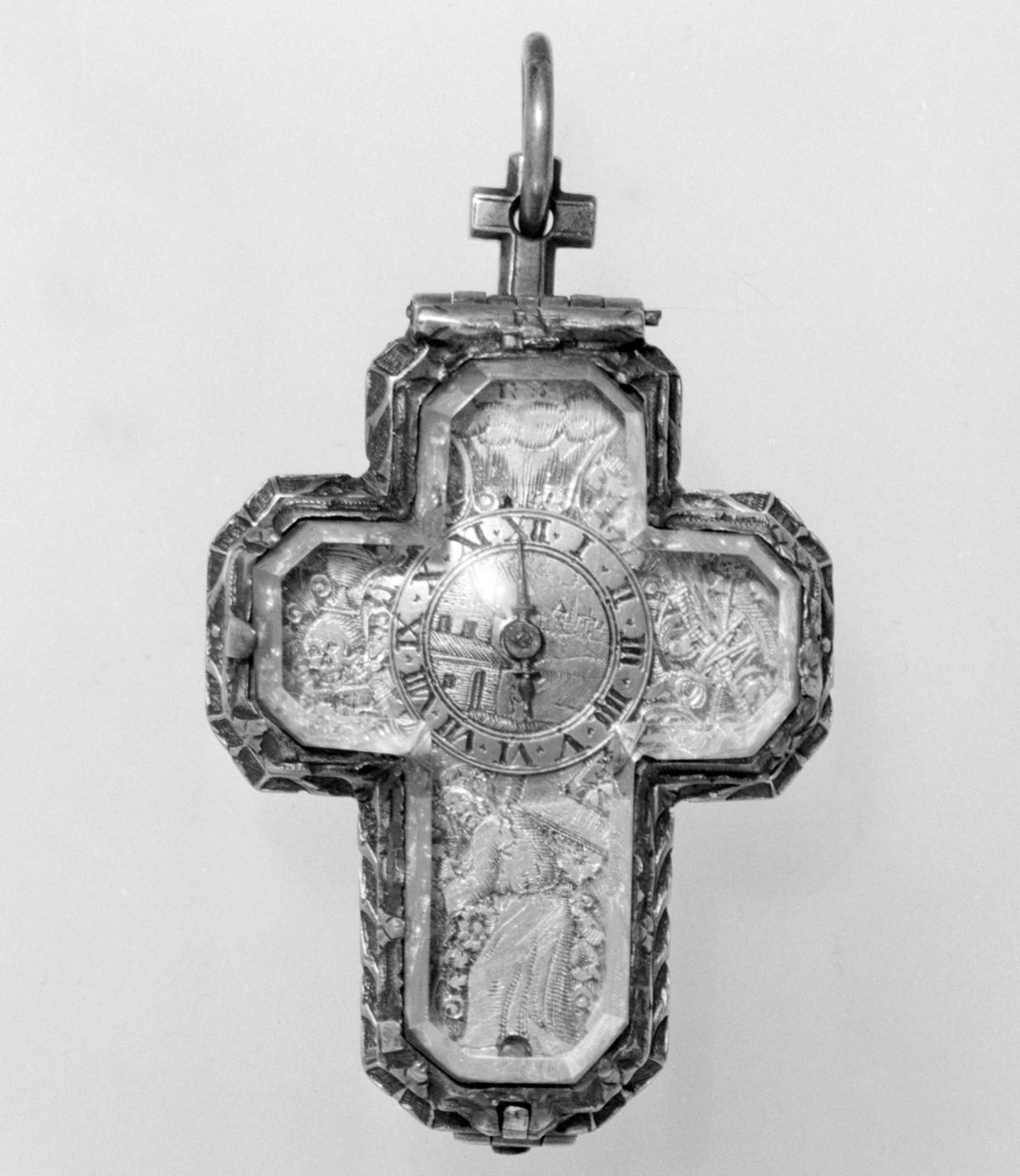
If you want a single test of what these objects were for, count the hands. A form watch of the 1630s has one, and the dial is divided into hours, sometimes with a half-hour mark and no more. Nobody commissions a carved crystal tulip on a gold mount in order to find out that it is approximately four o'clock. The decoration is not an indulgence added to a precision instrument; it is the product, and the movement is the mechanism that justifies carrying it.
That is also why the fashion is so tightly dated. It belongs to the window between the watch becoming small enough to wear — the story told on our page about the Nuremberg egg and the first watches — and the watch becoming accurate enough to consult.
Blois, Geneva, and the Enamel That Made It Possible
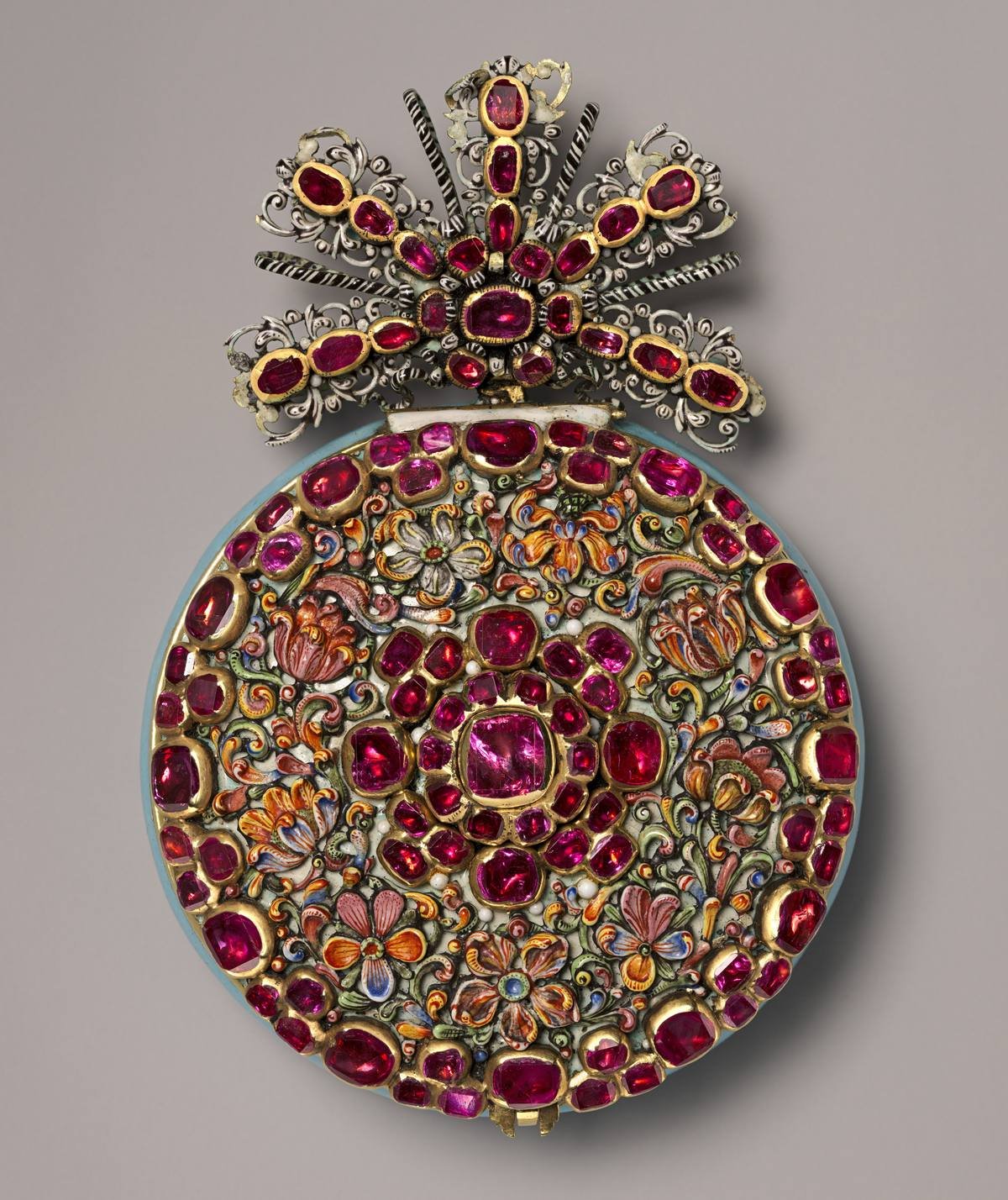
The technique that gave the form watch its late flowering was painted enamel, in which opaque coloured enamels are applied so that the finished surface reads as a miniature painting rather than as goldsmith's work. It is generally credited to Jean Toutin (1578–1644) of Châteaudun, working in the 1620s and 1630s; his son Henri (1614–83) carried it on. Their world was Blois — a centre for silver, watches and jewellery, and a Huguenot one.
That religious detail is not decoration. Blois, Geneva and London were connected by the movement of Protestant craftsmen out of Catholic France, and Geneva had been a refuge for Huguenot watchmakers since about 1550. When persecution intensified, enamelling and watchmaking skill went with the refugees; Geneva's later dominance of the decorated watch was built substantially on it. The names on the surviving watches follow the same map — Rousseau, Cusin and Penard in Geneva, the Toutins between Châteaudun, Blois and Paris — alongside the older German centres of Augsburg and Nuremberg and a strong London trade.
Why the Fashion Ended
It ended abruptly, and the cause is not taste. In 1675 a spiral spring was applied to the balance — Christiaan Huygens's name is the one usually attached to it, and Robert Hooke's rival claim is a story for its own article — and the watch stopped being an ornament that ticked. The Met's own summary of the change is worth the quotation: watches had at one stroke become serious timekeepers. Dials were recalibrated to register minutes.
Everything about a form case is then wrong. A minute hand needs a dial large enough to divide and plain enough to read at a glance, which a jawbone or a tulip does not provide. A movement that must be regulated needs to be got at, and cases shaped like animals are notoriously awkward to open. A watch consulted several times a day needs to survive being handled, and projecting ears, snouts and finials are exactly what breaks. The round or nearly round case won because it is the shape a circular movement asks for, it is the easiest to protect, and it is the easiest to read.
The Dating Problem — Three Famous Skulls
Here is the part that costs people money. The Victorian and Edwardian appetite for Renaissance-looking objects was enormous, and skull watches were made to meet it — some as honest novelties, some as revivals, and some as old movements rehoused in new cases to be sold as what they resembled. Three well-known skull watches illustrate the whole range, and in each case the dating comes from the museum that owns the object, not from a sceptic.
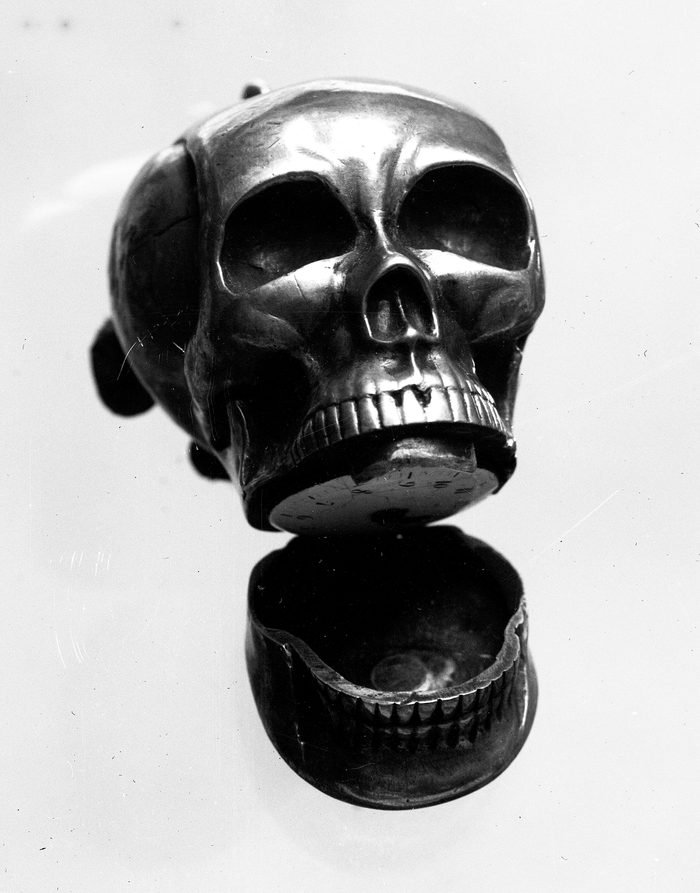
| The watch | The story attached to it | What the museum catalogues |
|---|---|---|
| The “Mary Queen of Scots” watch Clockmakers' Museum, on display at the Science Museum, London (L2015-3560) |
Given by Mary to Mary Seton on the way to her execution in 1587 | Dated 1780–1850. Signed Moysant, Blois on the movement — a signature the museum records as probably nineteenth century. And: it is one of three, first recorded in 1822 |
| The Penard skull Metropolitan Museum of Art, New York (17.190.1575) |
A Genevan skull watch by Isaac Penard, 1619–1676 | Case ca. 1810–20; movement ca. 1650. The movement is of Penard's period; the silver skull around it is not, and the Met attributes the case to the Geneva firm of Moulinié, Bautte & Moynier |
| The Thorne skull Walters Art Museum, Baltimore (58.18) |
None — it tells you what it is | ca. 1885, English, silver, inscribed Memento Mori, I. C. Thorne 1885. A Victorian novelty that has never pretended otherwise |
Read the middle row twice, because it is the one that generalises. Nothing about the Penard watch is a forgery. The movement really is a mid-seventeenth-century Genevan movement. The case really is a fine piece of early nineteenth-century Geneva silverwork — Jean-François Bautte lived from 1772 to 1837, so the firm named on it could not have made a case in Penard's lifetime. The object is honest in both halves and misleading only when the two are described as one thing with one date.
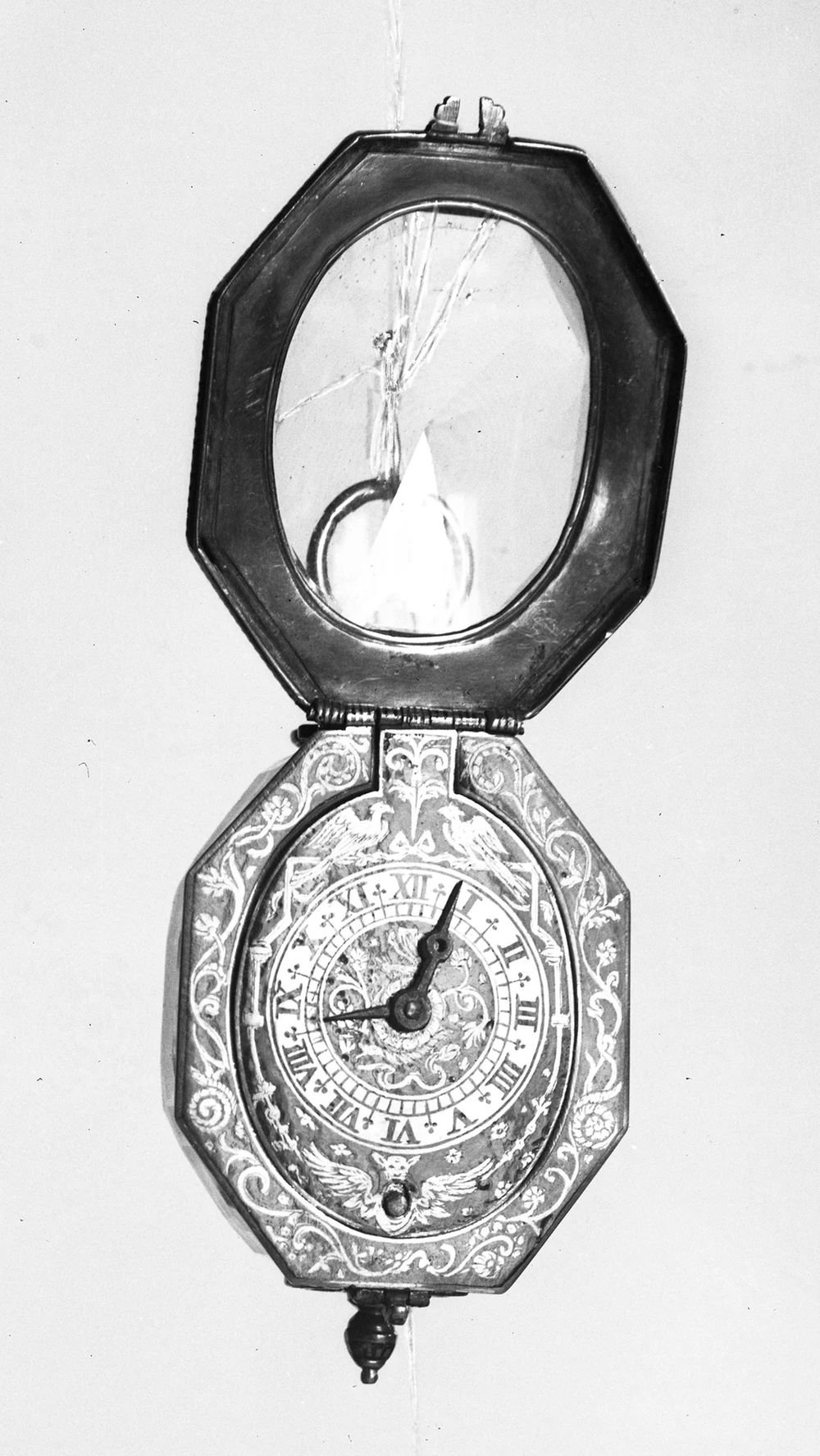
The Walters holds a second instructive example, and it is the better teacher of the two because you can see the seam being argued about. An octagonal rock-crystal watch from Amsterdam, decorated with birds and foliage, is catalogued simply as 17th and 19th century (58.15). That two-century span is not confusion; it is a museum declining to pretend that a composite object has a single date. And the dial gives the game away by the test in the callout above: it carries an hour hand, a minute hand and a minute track. No watch dial of the mid-seventeenth century was laid out that way, because until 1675 there was nothing worth dividing an hour into.
Our own Elgin history page reprints a magazine article of the 1870s that repeats the Mary Queen of Scots claim as plain fact, complete with the detail about the jaw dropping on a hinge and the works occupying the place of the brain. It has been on this site for years, and it is worth leaving there: it is the earliest thing on these pages that shows the legend already in full circulation, half a century after that first record of 1822 and a century before the Science Museum dated the object.
How to Read a Form Watch
Six habits, in the order they are worth applying.
- Date the case and the movement separately, and expect to write down two answers. Every one of the three watches above is a lesson in this. Ask the seller for both dates; if you get one date for the whole object, you have learned something about the seller.
- Treat the signature as evidence about the movement only, and weak evidence at that. A famous name in an unexpected place is the cheapest thing on the object to add. Our page on makers' marks takes this further.
- Look for a converted escapement. A great many surviving early watches have had their original verge replaced with a later escapement to make them run. It is usually visible in the balance cock and the layout of the top plate, and it is not a fault — but a watch sold as an untouched seventeenth-century survival should not have one.
- Compare the wear on the case with the wear on the movement. Two centuries of being carried leaves matching evidence on both. A crisp case around a worn movement is the Penard pattern, and it is common.
- Count the hands and read the dial divisions, per the callout above.
- Discount the story to nothing and then see what you would pay. The provenance tale is where the premium sits and it is the part with the least evidence behind it. If the object is worth the money as an anonymous silver skull watch of about 1820, buy it; if it is only worth the money as Mary Stuart's, do not.
The short version. Form watches were made in quantity between about 1550 and the 1670s, in skull, cross, book, shell, flower and animal shapes, because a one-handed verge watch had nothing else to sell. The balance spring of 1675 ended the fashion by making timekeeping worth paying for. The revival of the nineteenth century then produced a great many more, and three of the best-known skull watches are catalogued by their own museums as 1780–1850, ca. 1810–20 and ca. 1885.
Further Reading
- The Nuremberg egg — what the first watches were, and the museum forgery that shaped the story.
- History of the pocket watch — the full five-century overview this article sits inside.
- Verge and fusee watches — the movement inside almost every form watch.
- Pocket watch cases — types, sizes and construction.
- Identifying and dating a watch — what each feature settles, and what it cannot.
- Fake pocket watches — period Swiss fakes and how they are recognised.
- The fakes guide — including watches assembled from unrelated parts.
- Movement types — the verge, and everything after.
- All Horological History articles.