
Why Watches Have Jewels: The Patent Fight of 1704
The hard stone in a watch bearing is usually explained as an engineering decision, and it is one. But jewelling did not enter English watchmaking as an engineering decision. It arrived as a patent, and within eight months that patent had been carried into Parliament, contested by the trade it threatened, and cut back down to the narrow thing it started as. The argument was settled by a second-hand watch produced as an exhibit.
The Mathematician Who Drilled Rubies

Nicolas Fatio de Duillier was not a watchmaker. He was a Swiss mathematician, a Fellow of the Royal Society, and close enough to Isaac Newton to be one of the more conspicuous figures in Newton’s private life and in the long quarrel with Leibniz over the calculus. Some time in the 1690s he worked out how to drill a small, accurately round hole through a ruby using a diamond point.
That is a harder problem than it sounds, and it is the whole invention. Corundum is second only to diamond for hardness, so nothing softer will cut it; and a bearing hole is useless unless it is round, straight and the right size, because the pivot running in it is a fraction of a millimetre across. Fatio brought the idea to two Huguenot watchmakers working in Church Street, Soho — the brothers Peter and Jacob Debaufre — and in 1705 jewelled watches were shown to the Royal Society.
What Patent No. 371 Actually Covered
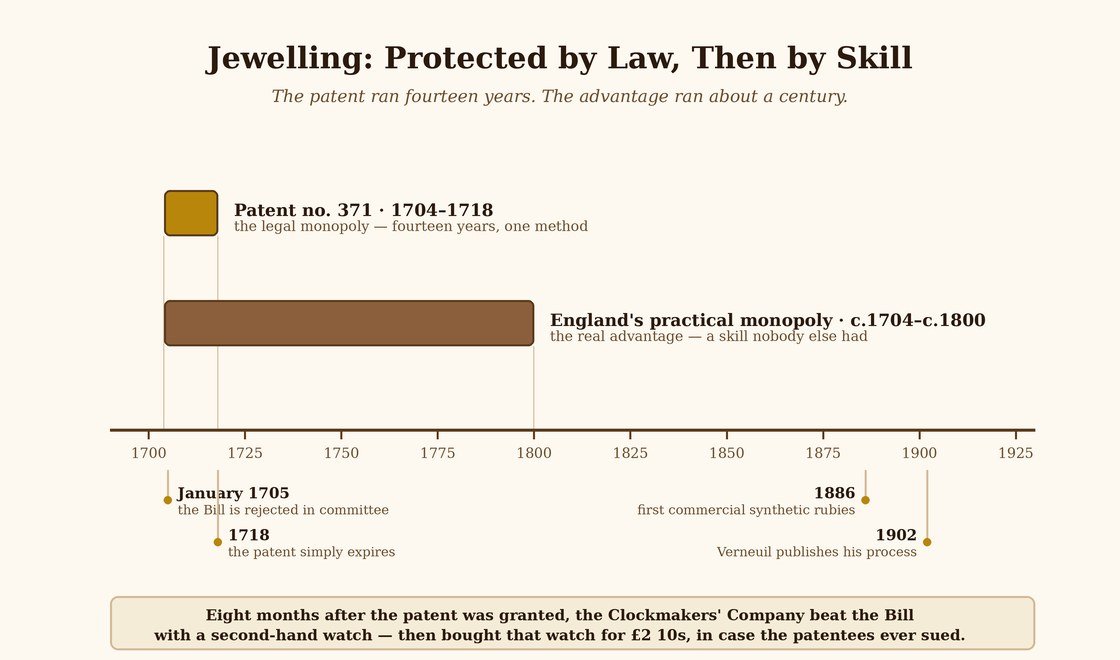
On 1 May 1704 the three of them were granted an English patent, number 371, running for fourteen years. Read narrowly, it covered a method: making bearings by piercing rubies in the way Fatio had worked out. That is a defensible thing to own. Nobody else could do it, the technique was genuinely new, and fourteen years was the ordinary term.
The distinction between owning a method and owning an application is the hinge of everything that followed, and it is worth holding on to before reading the next section.
The Overreach, and the Watch That Undid It
They did not stop there. On 11 December 1704 the Court of the Clockmakers’ Company was told that Fatio and the Debaufres had gone to the House of Commons seeking an Act for the sole applying precious and more common stones in Clocks and Watches, and to extend the term of the patent while they were about it.
That is a different claim altogether. It is not a claim on Fatio’s drilling technique but on the use of stones in watches at all — precious ones and, explicitly, commoner ones too. Granted, it would have made every jewelled watch in England their business for a generation. The Clockmakers’ Company, whose members would have had to buy permission to do something several of them could already do, objected.
And it produced an object. Before a committee of the Commons the Company exhibited an old watch signed by Ignatius Huggerford, which had a stone already fixed in the cock and the balance work — a watch that predated the patent and had a jewel in it. The committee recommended that the Bill be thrown out, and in January 1705 it was.
The Company then bought the evidence. It paid £2 10s to the watch’s owner, Henry Magson, and kept the watch with the Master of the Company in case the patentees ever brought a suit — and paid a further ten shillings to William Scale, who had testified that he owned the watch before the patent was granted and had sold it to Magson. A trade body buying a second-hand watch and filing it as a legal weapon is a very concrete piece of horological history, and the watch was worth more as an argument than as a timepiece.
The lesson was expensive and is perfectly clear in hindsight: had the patentees defended the drilling process alone they would probably have kept it. By reaching for every stone in every watch they invited the one rebuttal that beats any claim of novelty — somebody had already done it.
A Monopoly of Skill, Not of Law
Here is where the usual summary goes wrong. Jewelling is often described as having given England a protected monopoly for a century. The protection was never legal. The broad Bill failed in January 1705, and the narrow patent simply ran out in 1718.
What lasted was the difficulty. Drilling and shaping corundum stayed an obstinate, slow, specialised craft, concentrated in and around London, passed on by people who had learned it by doing it. A published patent tells a rival what you claim; it does not tell him how to hold the work. For most of the eighteenth century, a jewelled watch meant an English watch, not because a statute said so but because almost nobody else could make one.
That is why the story belongs in a history of the trade rather than a history of mechanisms. England kept jewelling by keeping a skill, and lost it the ordinary way — the Swiss learned to do it, and did it in volume.
The best evidence of how much the technique was worth is what the most demanding work of the century did with it. When John Harrison built the sea watch that finally solved the longitude problem, he jewelled the bearings of its train — not as decoration, but because a timekeeper expected to hold its rate for months at sea could not afford brass wearing into an oval.
When the Stone Stopped Being Precious
For nearly two centuries the jewels in a watch were fragments of real gemstone, generally offcuts too small to be worth cutting for jewellery. They were cheap as gemstones go and expensive as watch parts, and that combination is what made a jewel count worth printing.
Then rubies could be grown. The date usually given is 1902, when Auguste Verneuil published the flame-fusion process that bears his name, and that is the right date for the process becoming public. It is not quite the date synthetic rubies reached watches. Commercially made stones known as Geneva rubies were being sold from about 1886, and Verneuil had lodged sealed notes with the Paris Academy of Sciences in 1891 and 1892 while continuing to work. Priority here is genuinely untidy, and this site would rather say so than pick a clean year.
| Before synthesis | After synthesis | |
|---|---|---|
| Material | Offcuts of natural ruby, sapphire, garnet, diamond | Grown corundum, uniform and unlimited |
| Cost of one jewel | Small, but real | Negligible |
| What a high count signalled | Money actually spent on the movement | A decision to print a number |
| Limit on the count | What the buyer would pay for | What the marketing department wanted |
Reading a Jewel Count Against Its Date
This is the practical residue, and it is a different question from what the jewels are for or what a given count includes. Both of those are covered on our page on grades and jewel counts. The question here is what a count is evidence of, and the answer depends on which side of about 1900 the watch sits.
On an eighteenth or early nineteenth-century English watch, any jewelling at all is a statement of expense, and jewelled endstones — sometimes a rose-cut diamond rather than a ruby, chosen to be seen as well as to work — belong to good work rather than ordinary work. On a watch made after synthetic stones were freely available, a high count is much weaker evidence, because the extra stones had stopped costing the maker anything much. That is the honest reason a 17-jewel movement and a 21-jewel movement of the same period and maker can be closer in quality than the numbers suggest, and it is worth knowing before paying for the difference.
It also explains a pattern collectors notice and often misread. Very high counts on cheap movements are not a puzzle and not usually a fake; they are an advertisement, made possible by a chemical process and a set of trade customs that arrived at the same time. If a count looks implausible for the price, the thing to date is not the watch but the marketing.
Further Reading
- Grades and jewel counts — what the jewels do, what each count includes, and how grade affects value.
- Movement parts — where in the train the jewelled bearings actually sit.
- Harrison and the longitude problem — the timekeeper whose train was jewelled because it had to hold its rate at sea.
- Tompion & Graham — the London trade that the Clockmakers’ Company spoke for in 1704.
- Keyless winding — another case of a technical standard settled by commercial argument rather than by physics.
- All Horological History articles.