
The Balance Spring: The Leap to Accuracy
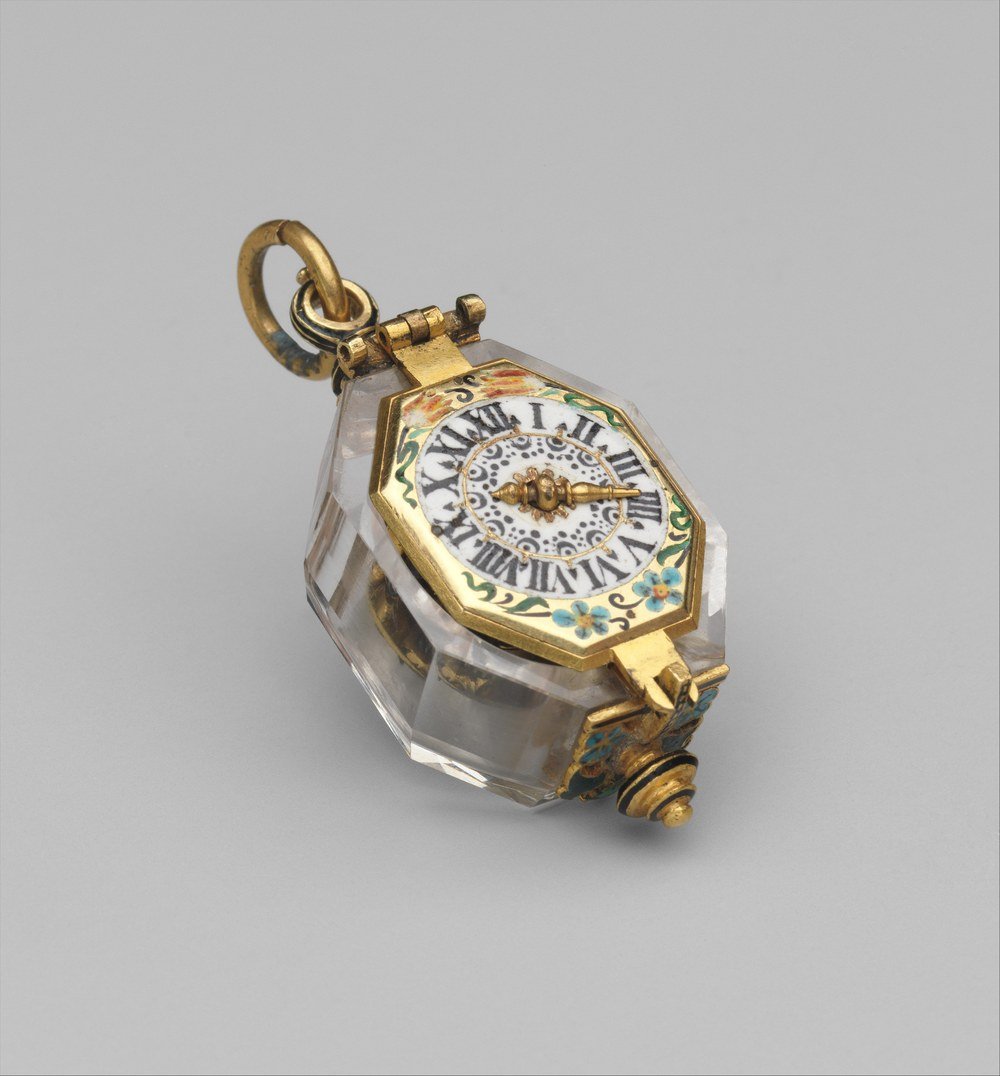
Everything else in this section of the site is a refinement. The first watches were spring-driven ornaments that told you roughly what part of the day it was. The form watches that followed were goldsmith's work with a movement inside. Then, in 1675, somebody wound a fine coil of steel around the arbor of the balance, and the watch stopped being an approximation.
The gain is difficult to overstate and easy to state. A good verge watch before the change might be a quarter of an hour out by the end of the day, and its owner set it by a sundial or a church clock whenever one was passed. After the change, a good watch was out by minutes. That is the difference between an object you consult and an object you trust, and every subsequent development — the lever escapement, the marine chronometer, the railroad grade — is built on top of it.
What the Spring Actually Does
A balance is a wheel that swings to and fro, and the escapement gives it a push on each swing to keep it going. In a watch without a balance spring, nothing decides how far it swings or how long it takes. The swing is governed by whatever force happens to be arriving from the going train at that moment — which changes as the mainspring runs down, changes again as the oil thickens or the watch is carried at a different angle, and changes when the wearer walks upstairs. The balance is a flywheel being shoved about. It has no opinion of its own about the length of a second.
Add a spring and the balance acquires one. Wound up by the swing in one direction, the spring pushes back; the further the balance is displaced, the harder it is pushed. The result is that the balance now has a period of its own that it prefers, and it returns to that period after being disturbed rather than simply doing whatever it was pushed into doing. The pendulum had given the clock this property a generation earlier and it is why clocks had leapt ahead of watches. The balance spring is the same idea rebuilt so that it works in a pocket, where a pendulum cannot go.
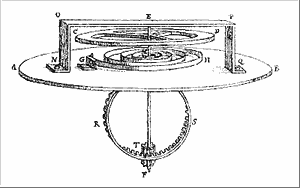
The elegance of it is that the spring is not an addition to the timekeeping; it is the timekeeping. That is why the hairspring is still, three and a half centuries later, the part a watchmaker treats with most respect and the part whose damage most often explains a movement that runs but will not keep time.
1675: Huygens Publishes
Christiaan Huygens is the name most often attached to the invention, and he has the strongest kind of claim there is in the history of science: he described the thing in print, in a journal, at a date everybody can check. The announcement went into the Journal des Sçavans in Paris in 1675, and it was reprinted almost immediately in London in the Royal Society's Philosophical Transactions.
Huygens had form. He had given the clock its pendulum in 1656 and published the mathematics of oscillation in Horologium Oscillatorium in 1673. A man who had spent twenty years on the theory of things that swing is exactly the man you would expect to arrive at this.
1676: Hooke Prints His Grievance
The reprint in London is what set the quarrel off, and we know this because Robert Hooke said so, in print, the following year. At the end of a short book on sighting instruments — A Description of Helioscopes, 1676 — he breaks off and adds a postscript that has nothing to do with helioscopes at all.
I should have here taken leave of my Reader for this time, but that finding in the Transactions a passage inserted out of the French Journal de Sçavans, about the invention of applying a Spring to the Ballance of a Watch, for the regulating the motion thereof, without at all taking notice that this Invention was first found out by an English-man, and long since published to the World…
Robert Hooke, A Description of Helioscopes, London 1676, p. 26What follows over the next five pages is one of the more remarkable documents in horology, because it is a man explaining, at length and with visible bitterness, why the most valuable thing he ever invented had spent fifteen years in a drawer. Hooke says he had the idea in 1660 and negotiated to sell it:
About fifteen years since, to wit, in the year 1660, presently after his Majesties happy Restauration, I was in treaty with several Persons of Honour… in order to bring this Treaty to pass, I was necessitated to discover something of Invention about measuring Time, which was, this way of applying springs to the arbor of the Ballance of a Watch, for the regulating the vibrations thereof in all postures.
Ibid., pp. 26–27And then the deal collapsed, over a single clause. His backers wanted the right to any improvement anyone else might make on his principles — during the term of the Pattent, and not I. Hooke, who knew perfectly well that it was easie to vary my Principles an hundred waies, refused. His own account of the consequence is four words long: our Treaty was broken off, and he concealed the rest.
He also gives dates and a venue that could have been checked by anyone alive at the time. In 1664 he read his first Cutlerian Lectures in the open hall at Gresham College, where, he says, he shewed the ground and reason of that application of Springs to the Ballance of a Watch and explained above twenty several ways in which a spring might be made to do it. He says he had watches made to it in 1664 and 1665.
| Christiaan Huygens | Robert Hooke | |
|---|---|---|
| Claimed date of the idea | 1675 | 1660, with a lecture in 1664 and watches made 1664–65 |
| Published when? | 1675, in the Journal des Sçavans, reprinted in the Philosophical Transactions | 1676, in a postscript to a book about sighting instruments |
| Contemporary evidence a reader can consult today | The journal article, and twenty years of published work on oscillation behind it | His own testimony, naming living witnesses and a public lecture; the papers he says he still held were never produced in print |
| Why the gap, on his own account | — | A patent clause he would not sign, and a decision to conceal the rest |
| What he said about the other man | Did not name Hooke | That Huygens might therefore, if he had pleased, have mentioned the first Inventer |
Hooke's parting shot is worth reading twice, because it is a technical criticism and not only a territorial one. He argues that Huygens has only the first half of the invention, and that a watch built on that half alone
…is but lame and imperfect, and doth but limp on one leg, and will some time hobble, and stumble, and stand still.
Ibid., p. 30A Footnote Worth Having: What Hooke Chose to Encrypt
The last page of that same book carries a list of ten inventions Hooke intended to publish later. Several are printed as anagrams, so that he could prove priority afterwards without giving anything away. The third reads The true Theory of Elasticity or Springiness, followed by the letters ceiiinosssttuu — which unscramble to ut tensio, sic vis, as the extension so the force. That is Hooke's law, and it is the physics the balance spring runs on.
The detail collectors usually get wrong is which way round these two things go. The anagram is not a coded claim to the balance spring. Item one on that same list, a way of regulating all sorts of watches and timekeepers, he states openly in plain English with no cipher at all. He encrypted the theory and published the application. If you meet the claim that Hooke hid the balance spring in a 1660 anagram, it is a confusion of the two.
The Change You Can See: The Minute Hand
None of this would matter to a collector if it had not changed the object. It changed the object completely, and the change is on the front.
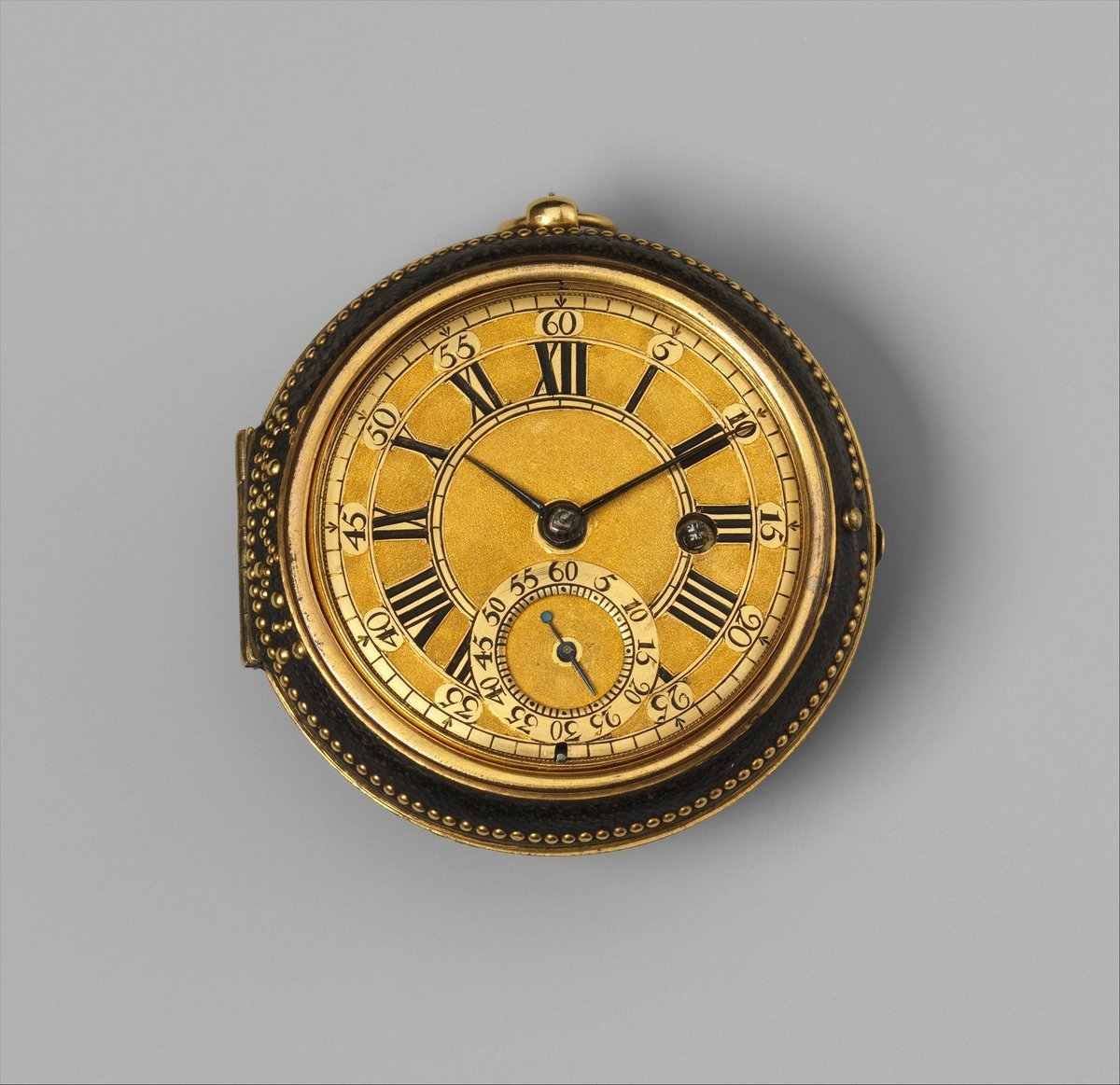
A minute hand on a watch that gains or loses a quarter of an hour a day is a joke in poor taste. The hand is only worth fitting when the movement can hold the minute it is pointing at, and dials acquired minute tracks in the years immediately after 1675 for that reason and no other. This is the single most useful dating tool the balance spring gives a collector, and it works in both directions — a plain hour-only dial suggests a watch before the change, and a minute track on a case that looks much older than 1675 suggests a dial, or a movement, that has been changed. Our identification guide sets out where that fits in a full examination.
What It Looks Like Inside
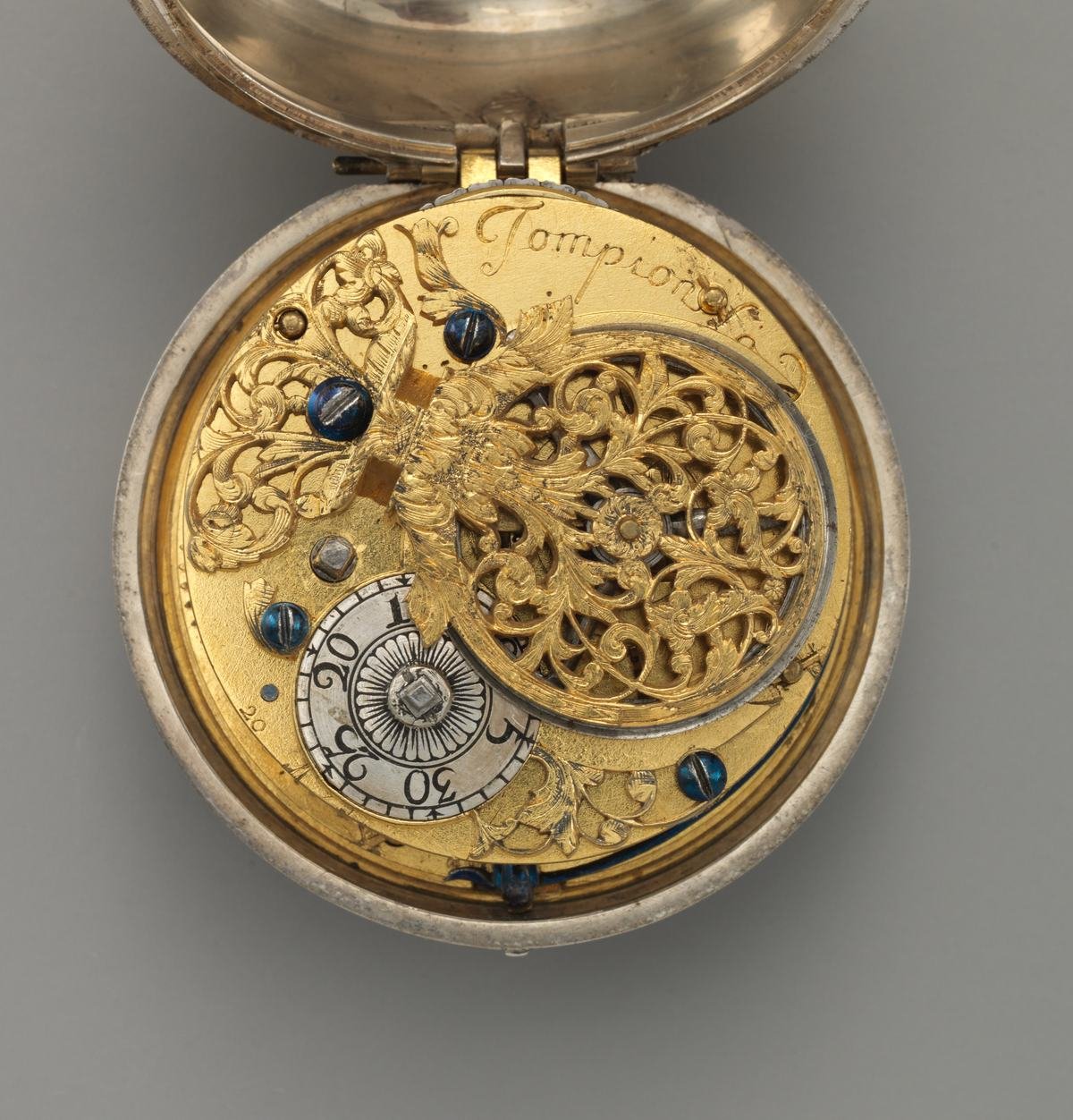
The balance cock is the reason English watch movements of this period look the way they do. Once the balance had a spring, the balance became the thing worth protecting and worth showing off, and the bracket over it grew from a plain strap into the pierced and chased centrepiece that dominates every English movement for the next century and a half. Our page on movement types and plate architecture follows what happened to it afterwards. On the collecting side, the cock is one of the more reliable indicators of quality and of national origin, and it exists in that form because of what was put underneath it in 1675.
Who Built the Watches
Neither Huygens nor Hooke was a watchmaker, and the invention reached the public through the trade. In London that meant, above all, Thomas Tompion, whose workshop was turning out sprung-balance watches within a few years of the announcement — the two objects photographed on this page are his, and they are dated by the Metropolitan Museum to 1682–83 and 1685–86. It was taken up fast. A trade that had spent a century selling decoration because it could not sell accuracy switched to selling accuracy within a decade, and the decorated case never recovered its place.
Further Reading
- All Horological History articles — the section index.
- The history of the pocket watch — the whole story in one place.
- The Nuremberg egg — what the earliest watches really were.
- Form watches — the century of decoration that the balance spring ended.
- Tompion and Graham — the London workshop that built the new watches.
- The marine chronometer — where the accuracy problem went next.
- Movement types — the verge, and everything after.
- Identifying and dating a watch — what each feature settles, and what it cannot.