
The Rise and Fall of English Watchmaking
In 1796, according to a return laid before the House of Commons twenty-two years later, 191,678 watches were stamped at Goldsmiths' Hall. England made the best watches in the world and a great many of the ordinary ones, and the men whose names this section of the site is built around — Tompion and Graham, Mudge, Arnold and Earnshaw — were within living memory. A hundred years later the trade that produced them was finished.
The usual explanation is that the English were too proud to use machinery and were beaten by people who were not. Pride came into it. But pride describes a choice, and the English trade was not in a position to make one: it had the finest division of labour in the world and no factories to put it in, and by the time anyone built the factories the argument was already over.
The Trade That Owned the World's Time
That figure needs handling with care. The Victoria County History notes that it “has never been equalled before or since” and warns that it probably includes “large numbers of the inferior watches with forged makers' names” — the eighteenth century's own counterfeit problem, which the site covers on fake pocket watches; a high-water mark, then, rather than a measurement.
Even so, what happened next is not in doubt. By 1842 a contributor to Knight's London put the annual average passing the Hall at 14,000 gold and 85,000 silver — call it 99,000 watches. The English trade had roughly halved before a single American machine-made watch existed. Aaron Dennison did not begin at Waltham until the 1850s. Whatever killed English watchmaking, it had done half its work before the usual suspect arrived.
A Factory Without a Roof
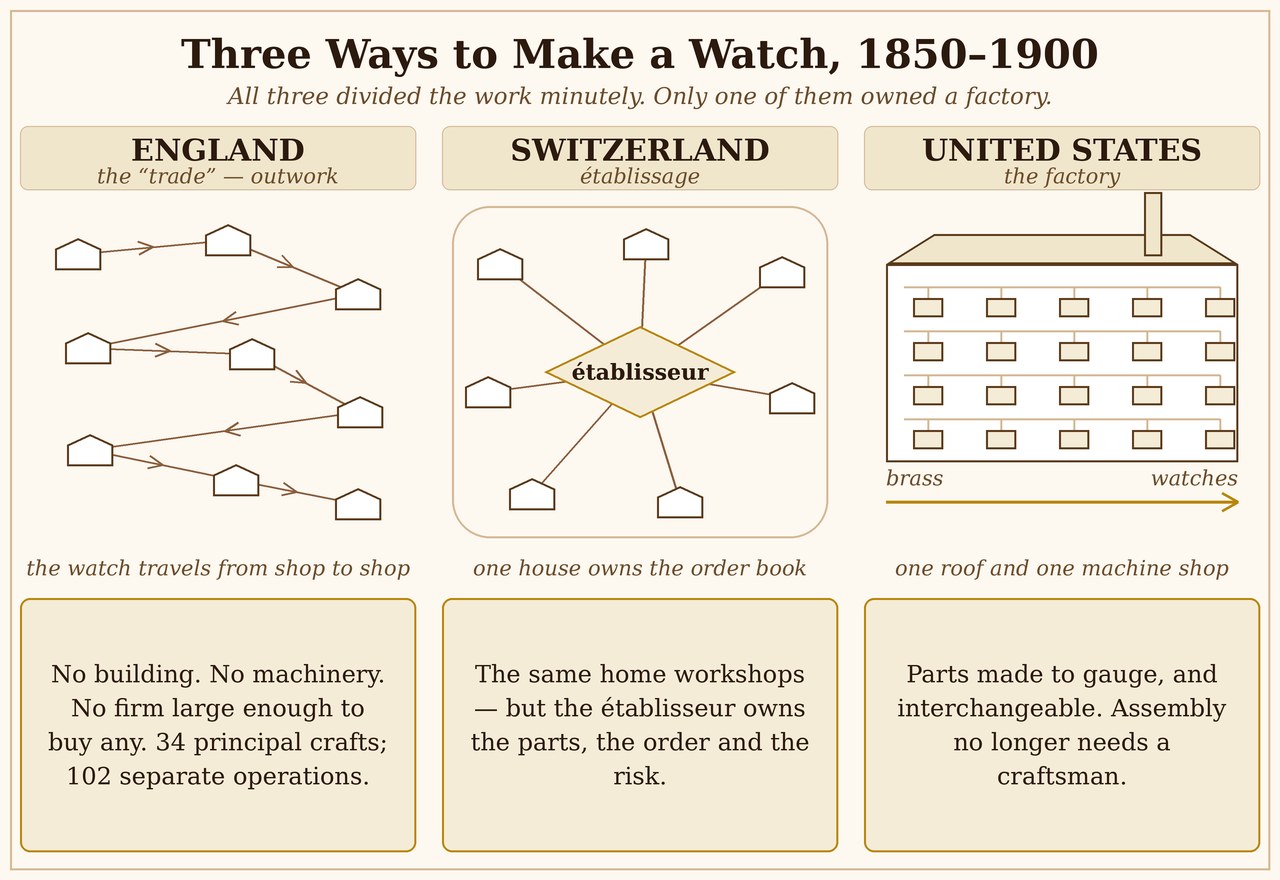
An English watch was not made in a workshop; it was made across one, or across a county. Prescot in Lancashire supplied the rough movement — the plates, the wheels, the frame — and rough movements went out to the finishing centres at Liverpool, Coventry, Birmingham and, above all, Clerkenwell, which had been the working heart of London watchmaking since the seventeenth century.
Assembly is the wrong word for it. What happened was a procession: the escapement maker, the wheel-cutter and the pallet-maker; the jeweller; the fusee cutter; the springer and the secret-springer, who fitted the concealed spring that flies a hunter cover open; the motion maker; the engine turner; the dial maker; the case maker and the gilder; the joint finisher; and the finisher, who put it together and made it go. A watch was carried, by hand, from one small shop to the next, and each shop was an independent business paid by the piece.
Two contemporaries tried to count the stages. The Reverend William Pearson, writing in 1817–18, listed thirty-four principal crafts, many of them subdivided again. A separate estimate of the same period put the number of distinct operations at 102. Adam Smith admired the division of labour; the English watch trade carried it further than any pin factory ever did, and carried it on entirely in bedrooms, attics and back kitchens.
The system wanted for nothing in organisation, skill, specialisation or scale. What it wanted for was fixed capital — a building, machinery beyond hand tools and the turns, and, above all, a firm. The man whose name went on the dial owned a shop-front, a set of accounts and a reputation; he did not own a works. So when the moment came to buy a machine shop, nobody in England was in the right shape of business to buy one.
The Man Who Tried to Build a Factory
Someone did try. Pierre Frédéric Ingold, a Swiss who had worked for Breguet, arrived in London in the early 1840s with a set of duplicating tools of his own design and a plan to make watch parts to gauge by machine. The British Watch Company was established in 1843 at 75 Dean Street, Soho, and applied for incorporation.
The trade destroyed it. The application was opposed — successfully — and the company failed. History remembers that as blind conservatism. Partly it was, and partly it was something less comfortable. Tens of thousands of outworkers held their skill as their only capital. Ingold's proposition was that the skill should become unnecessary. No version of that argument has the springers of Clerkenwell behaving irrationally, and the practical result was that English mechanisation was set back by roughly a generation.
Karl Marx, writing about watchmaking in Capital in 1867, used the trade as his example of what he called heterogeneous manufacture — an industry whose separate operations “may further be carried on like so many independent handicrafts”. His figures for the alternative are worth having:
In the year 1854 Geneva produced 80,000 watches, which is not one-fifth of the production in the Canton of Neufchâtel. La Chaux-de-Fond alone, which we may look upon as a huge watch manufactory, produces yearly twice as many as Geneva.
Karl Marx, Capital, Volume I, chapter 14, footnoteTwo Rivals, Two Different Answers
Switzerland's établissage looked, from a distance, exactly like the English trade: home workshops, piecework, minute specialisation, a mountain valley instead of a London parish. The difference was the établisseur. He owned the parts, the order book and the risk, so there existed a business with a balance sheet that could be pointed at a machine. When the Swiss took fright — and they did, spectacularly, at Philadelphia in 1876 — there was something there to reform. The story of what they saw, and of Jacques David's report, is told on its own page.
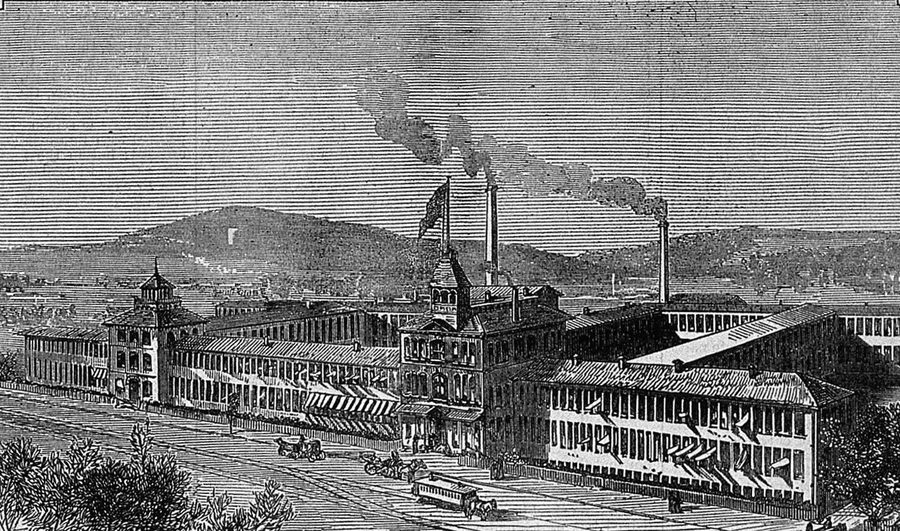
America did not reform an existing trade, because it had almost none to reform. It built the thing from nothing, around the principle that parts made to gauge are interchangeable and that assembly therefore need not be craft work at all. The American industry that resulted is covered elsewhere on this site. One figure carries the comparison: fifty years after Aaron Dennison set up at Waltham, the factory he started was finishing 2,500 watches a day.
England also disarmed itself. Import duty on watches stood at 25 per cent before 1840, was cut to 10 per cent in 1842, and was abolished altogether by Gladstone in 1860. Declared watch imports rose from £5,085 to £52,622 after the 1842 reduction alone — a tenfold increase, into a home market the English trade had assumed was its own.
England Did Build the Factories — Thirty Years Late
England built machine watch factories, and they worked. At least four firms made watches by machine in England, and the largest of them ran for twenty years.
William Ehrhardt opened a Birmingham workshop in 1855 and by 1880 was making 500 watches a week, “some by hand and some by machine”. In that same year John Rotherham of Coventry sent his works manager to America to buy watchmaking machinery — a firm tracing its descent to 1747 going shopping in Massachusetts. By 1899 Rotherham & Sons were turning out 100 watches a day with 400 to 500 employees and 200 outworkers still attached. The English Watch Company of Birmingham had been at it since 1871.
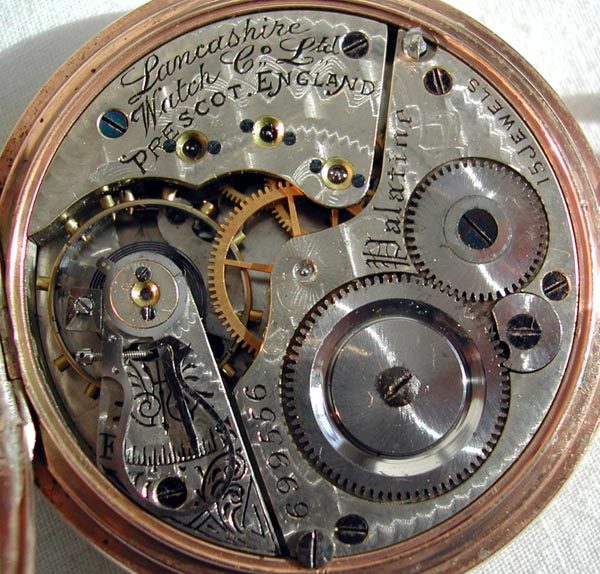
And then there was Prescot. The Lancashire Watch Company was registered on 5 December 1888 as, in the words of the contemporary record, “a practical amalgamation of almost all the watch movement makers in Prescot, and three firms outside the town”, with T. P. Hewitt as managing director. Its purpose-built works on Albany Road came into production in 1890. By 1894 a visitor recorded output of 500 watches a day. Some accounts date the founding to 1889; the registration date is the firmer of the two claims and is what this page uses.
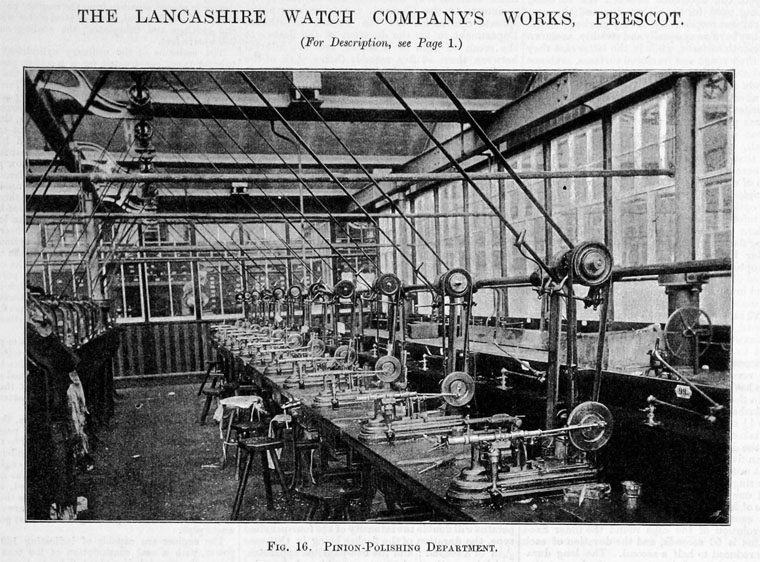
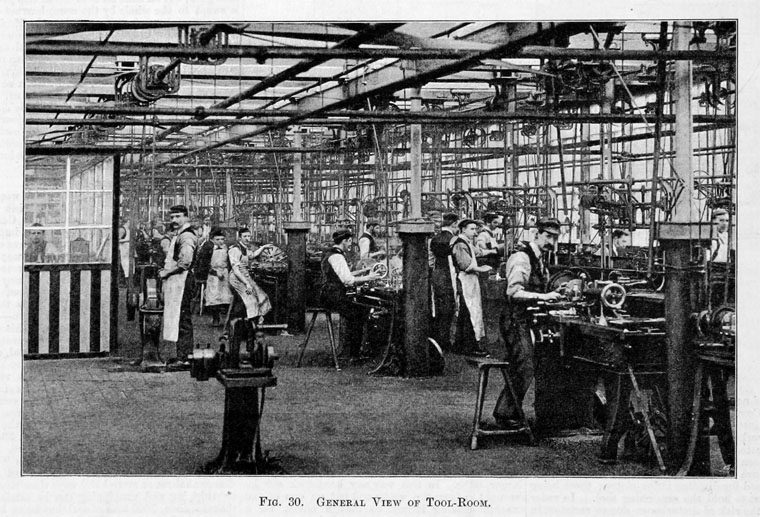
The photographs The Engineer published in 1893 are the best answer to the idea that England could not do it. They show a tool room, a pinion-making department, a pinion-polishing department and purpose-designed single- and four-spindle pinion-cutting machines — a proper machine-tool culture, in Lancashire, doing what Waltham did.
What the photographs cannot show is the commercial position. An estimated 70 per cent of the factory's output went to a single customer, J. G. Graves of Sheffield, the mail-order house, sold under its own names. England's most modern watch factory survived as a catalogue supplier — which is not a criticism of Graves, who was a rational buyer, but is a fair description of how little of the market the factory could reach in its own right.
The Arithmetic That Settled It
| Maker | Where | Recorded output | Date |
|---|---|---|---|
| William Ehrhardt | Birmingham | 500 watches a week | 1880 |
| Rotherham & Sons | Coventry | 100 watches a day | 1899 |
| Lancashire Watch Co | Prescot | 500 watches a day | 1894 |
| American Watch Co | Waltham, Massachusetts | 2,500 watches a day | c.1900 |
England's best factory, at its best, made in a day what Waltham made before lunch. But the sharper comparison is not output — it is output per person, and two figures happen to survive that allow it to be attempted.
In 1891, Coventry employed 4,100 people in watchmaking, of whom 534 were women. Around 1900, Waltham employed 1,400 women and 500 men — 1,900 people — and made 2,500 watches a day. Coventry's whole trade at its nineteenth-century peak is generally put at about 100,000 watches a year. On those numbers Waltham produced something like fifteen times as much per worker.
That ratio is arithmetic on figures from three different sources, gathered for different purposes and probably counting different people, so treat it as an order of magnitude and not a measurement. It does not need to be precise. A gap of that size is not closed by working harder, and the second number in each pair says something else worth noticing: the American factory was staffed overwhelmingly by women, and the English trade was not. Deskilled work and the labour to do it arrived together.
And the Watches Themselves Were Behind
Structure was not the only problem. English makers kept the fusee — a beautiful device for evening out mainspring power, and an expensive one — long after the Swiss and the Americans had abandoned it for the going barrel. They kept key-winding while the rest of the world went over to keyless work. English watches were, at the cheaper end, better made than they needed to be and dearer than anyone wanted.
At the top end there was a different gap. Usher & Cole of London, one of the most respected English houses, acknowledged sending movements to Switzerland for complication work and returning them with “not more than 10 per cent foreign work” in them. The country that had given the world the lever escapement was buying in its chronographs and repeaters.
One late English invention catches the whole predicament. In the 1890s Bahne Bonniksen, a Danish-born watchmaker working in Coventry, patented the karrusel — a rotating escapement carriage that achieves much of what Breguet's tourbillon achieves, driven from the train rather than by its own arbor, and specifically designed to be cheaper to make. England's best horological idea of the period was a way of making an expensive complication affordable. It was exactly the right instinct, and it arrived about thirty years too late to matter.
The Last English Factory
The Lancashire Watch Company never made money. By 1899 its shareholders were telling its directors that the accounts did not represent the position of the business; the directors expected profits eventually and would not promise them. The company failed in 1910 and the closure of the works was announced in January 1911. The building still stands on Albany Road, listed, and is now flats.
Coventry went the same way by a different road. The Coventry Watch Movement Manufacturing Company, founded in 1889 to keep the city independent of Prescot, ended up as Lancashire's Coventry agent and then gave up watches for bicycle and motor-car parts; in 1912 it dropped the word from its name. The city that had roughly a hundred watch manufacturers at its peak had about thirty by the First World War. The wristwatch finished the argument: retooling for it needed capital that firms already losing money did not have.
The coda is a strange one. In August 1945 the Anglo-Celtic Watch Company was incorporated — Smiths, Ingersoll and Vickers-Armstrongs in equal shares — and in March 1947 it opened the Gurnos Works at Ystradgynlais, near Swansea: the largest watch factory in Britain and one of the largest in Europe. Between 1946 and its closure in 1980 it made over thirty million watches, exported to sixty countries. Britain did eventually build the factory. It built it in Wales, a century after Ingold asked for one, and it closed for reasons — quartz, and Asian manufacturing — that had nothing to do with Clerkenwell.
Collecting English Watches Today
For a collector, all of this splits the phrase “English watch” in two, and the market values the halves very differently.
The first is the hand-finished English watch: fusee, key-wound, signed by a finisher or a retailer, often in a hallmarked English silver or gold case. These are the products of the trade described at the top of this page, they are frequently very good, and their value turns on the maker, the movement and the case — the ordinary considerations set out under what an antique pocket watch is worth.
The second is the English machine-made watch — Lancashire Watch Company, Rotherham, Ehrhardt, H. Williamson, the English Watch Company. These carry grade names and serial numbers on the plate in the American manner, and they are among the least collected industrial watches anywhere, largely because most people do not know England made any. A signature giving a town and a grade rather than a person's name is the tell. They are cheap, they are historically pointed, and there are not very many of them.
For the marks stamped inside the case, see case markings and English silver hallmarks; for the movement itself, movement types and grades and jewel counts.
Further Reading
- All Horological History articles — the section index.
- 1876: the Centennial Exhibition — the moment the Swiss took fright and the English did not.
- The American watch industry — the system that won, maker by maker.
- The Swiss watch industry — établissage and what became of it.
- Tompion and Graham — the London workshop at the beginning of the story.
- Keyless winding — the change English makers were slowest to adopt.
- The tourbillon — and Bonniksen's cheaper Coventry answer to it.
- Identifying and dating a watch — where a signature helps, and where it misleads.